

This week I ventured “North of the River” (Wey) into what might reasonably be described as Surrey stockbroker territory. When the enquiry first came in I was slightly surprised (my infamy clearly travels further than I realised) and initially a little hesitant. I know the soils there only vaguely (mostly from hacking away at golf course fairways), the additional travel time is significant, and my usual suppliers would either be unwilling to deliver that far or would charge delivery rates that quickly become unrealistic—which, as it turned out, was indeed the case.
Nevertheless, I asked for a few photos and a brief outline of the work while I considered it. The client kindly sent a video with a voiceover explanation, and it did not take long to decide that it might actually be rather fun to escape the ‘Three Counties’ bubble for a change. I would treat it as a small expedition—and besides, surely the stockbrokers must get their plants from somewhere.

Over the following days we agreed a clear brief and terms remotely, including a generous budget for new planting. I met the clients on Monday to shake hands and see the project in person. Both they and the property were delightful, and it was immediately clear they were straightforward people I could work with. The job itself, however, turned out to be somewhat larger and more demanding than the video had suggested. Unfortunately this meant I would have to work rather hard—but I remained confident I could deliver within the agreed timeline and fixed price.
The next challenge was finding suppliers. There is a prominent garden centre chain nearby—the sort of place that starts selling Christmas decorations in summer and dedicates as much floor space to scented soap as it does to slightly plastic-looking hydrangeas. Pleasant enough for a leisurely outing if one has abandoned all hope, but not what I was after. I needed somewhere authentic: a proper nursery with semi-mature, locally grown plants that had a bit of character.
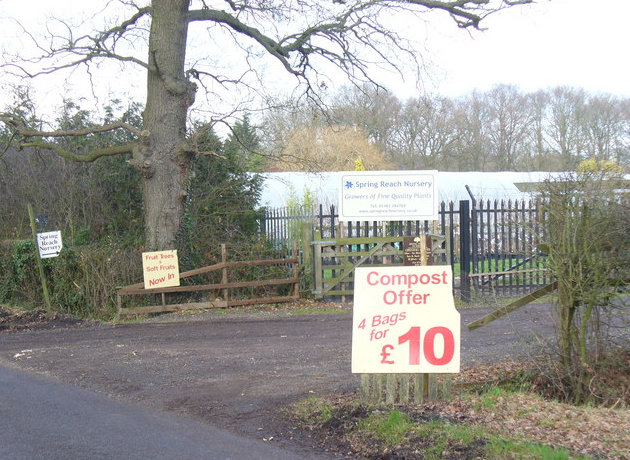
In my view we rather undervalue plant nurseries. Many people find them slightly intimidating, assume they are only for professionals, or simply overlook them because they sit quietly off the beaten track. Having done some research beforehand, I set off with a short list of smaller nurseries and garden centres to visit. One of them was Spring Reach Nursery. Their website appears to have been designed by a five-year-old in 1989, so my expectations were modest.
On arrival, however, it quickly became clear that while their IT offering may not have reached the 21st century (thankfully they do possess a card reader), they have been focusing on what they actually do best. I knew immediately I had found the right place—and where about 95% of my planting budget would be spent. The other 5% inevitably went on some identikit foliage from the large garden centre down the road.
The haul included a truckload of compost, a beautiful magnolia, hydrangeas, camellias, azaleas, alliums, euphorbia, Portuguese cherry laurel, dogwood and a substantial collection of excellent perennials—quite necessary given that roughly 18–20 square metres of beds needed planting from scratch. If you ever find yourself visiting Wisley, it is well worth making a small detour to Spring Reach near Horsley. The staff are knowledgeable, friendly and extremely helpful, and the stock is terrific.
Tuesday was dedicated to clearing the severely neglected beds ready for planting the following day. Overnight, however, they appeared to have deteriorated even further. My first attempt to push a fork into the foot-high mound of overgrowth bounced off as if I were attempting to dig into concrete. A small trickle of concern followed as I surveyed the two larger beds, each roughly four by two metres.
I soon discovered the reason: the soil here is about 90% clay. You could practically cut it from the ground, slap it onto a potter’s wheel and—add a bit of *Unchained Melody*—you have the makings of a romantic film. While we have almost every other soil type within the Three Counties, I have not encountered this extreme. Clay is incredibly fertile and does not encourage weeds, which explains why the lawn already looks excellent, albeit slightly soft and waterlogged. Unfortunately, in the flower beds the clay had been repeatedly dug up and piled over the years, then baked hard by the sun into something resembling a cap on an abandoned nuclear power station.
As explosives were not readily available, the only practical solution was to cut down the vegetation, attack the surface with a rather serious strimmer acting as a scarifier, and then spend the rest of the day with a pickaxe imagining the faces of everyone who has ever wronged me and going full Viking berserker.

When I returned the next morning it appeared that the previous day’s efforts had been successful: the clay mounds had been subdued. All that remained was to tidy and edge the beds before an afternoon of planting. The clay attempted one last resistance—clinging to boots, tools and anything else within reach—but by lunchtime the end was in sight and the enjoyable part of the job could begin.
By late afternoon the beds were planted, mulched with compost and ready to establish themselves. The result is a garden that should flourish with minimal maintenance throughout the year and beyond —along with a few new muscles I did not previously know I possessed. The client must be happy as I will be returning for another project next month.
Most importantly, a small beachhead has now been established in a new territory. Stockbrokers and footballers of Surrey should consider themselves warned: OT Garden Rescue has crossed the Rubicon—although next time I may leave the red braces at home.

Add comment
Comments