


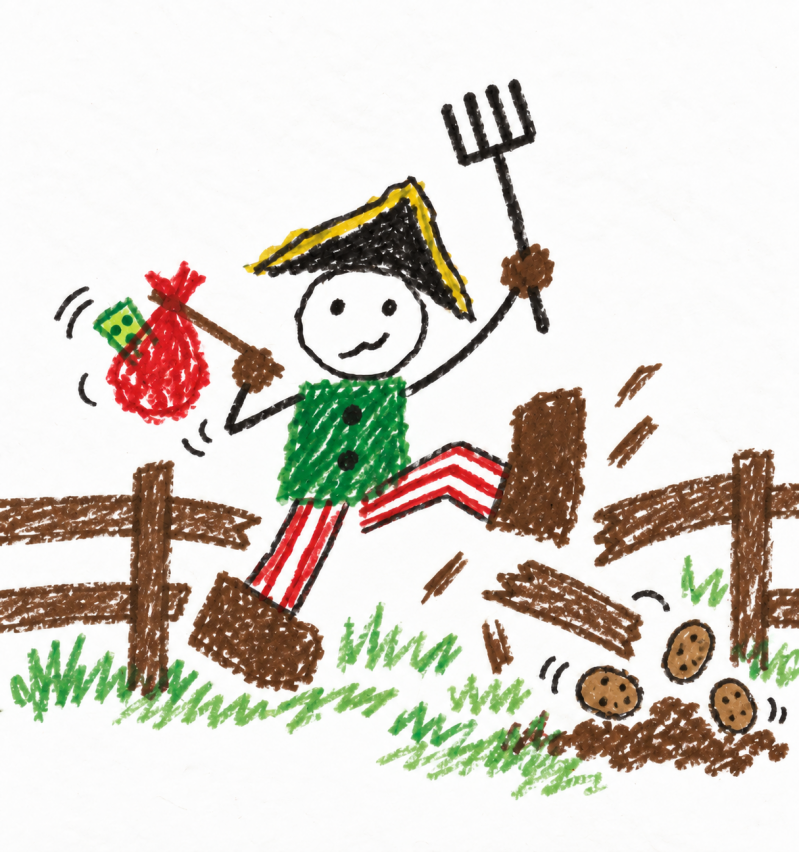
Four hundred years ago, Captain Pouch wanted a potato patch.
This was not how he expressed the matter. He tore down fences, encouraged revolt and claimed to
possess a magical pouch that would protect his followers from harm.
When the authorities finally opened it, they seemingly found just a piece of stinking green cheese.
Captain Pouch was the name adopted by John Reynolds, one of the leaders of the Midland Revolt of
1607. Across Northamptonshire, Leicestershire and Warwickshire, thousands joined protests against
enclosure: the fencing and hedging of land previously used for common grazing and cultivation.
The authorities called them rioters. The protesters saw land they had always used and now could not.
Captain Pouch promised that his pouch would protect them.
It did not.
The revolt was suppressed. Its leaders were captured. The fences remained.
The pouch apparently failed — the argument seemingly did not
Give Him a Garden — Improve His Character
The history of the allotment is often presented as a benevolent one: landowners, clergy and Parliament gradually gave poor people small pieces of ground on which to grow food.
That is true, but incomplete.
The people providing the land were interested not only in vegetables, but in the behaviour of the person growing them.
A labourer with an allotment, it was argued, would become industrious, sober and respectable. He would feed his family instead of demanding relief - he would spend his evenings digging rather than discussing politics or visiting what one landowner called “those pests, the beer-houses”.
The thought was the allotment cultivated the tenant as much as the tenant cultivated the allotment.
This was horticulture as social policy. A little land might improve the poor without requiring much alteration to the system that had made them poor. It offered food, occupation and a carefully supervised degree of independence.
The principle was simple: give Captain Pouch a garden before he starts drinking, rioting and smashing up the fences again.
Families grew potatoes and vegetables on land that had previously produced nothing. Such was the adoption rate that one account records crops being tended by moonlight after the ordinary working day had finished.
Not every experiment in improvement succeeded. One former marine blamed his failure on “the worst land and the worst wife in the parish” — with this level of self-pity, one wonders if it might not all have been her fault.
Elsewhere, a labourer who had received a plot supplied the wonderfully direct verdict:
“We needn’t steal now, sir.”
To the reformers, this proved that the allotment was performing its moral function. To the labourer, it may simply have meant that his family finally had enough potatoes to survive.

You May Have Your Allotment — Subject to The Small Print
Once the land was provided, the rules followed.
These did not merely require tenants to cultivate their plots. Some schemes attempted to control how they worked, when they worked and how they behaved when they were nowhere near them.
Sunday cultivation became a recurring concern. In some places tenants could not work their allotments on a Sunday. Elsewhere they might enter the land but were forbidden to collect produce. The potatoes apparently observed the Sabbath even when the labourer’s hunger did not.
Church attendance, bad language, drunkenness, political agitation and failure to appear before a committee could all determine whether a man remained entitled to grow his cabbages. The tenant was not simply renting soil. He had entered a small moral jurisdiction.
Even the method of cultivation might be prescribed. Some plots had to be worked by spade husbandry: dug by hand rather than treated as miniature farms. The authorities had given the labourer land, but they were not prepared to leave him unsupervised with it — the rules would be enforced by fines or forfeiture of the plot.
At this point I would like to say and this is where the famous phrase — Lost the Plot — comes from. Unfortunately I can find absolutely no evidence whatsoever that this is the case — so let's say it anyway — and this is amazingly where the phrase, he's totally 'lost the plot' comes from. Amazing. Totally.
The 'bargain' was extraordinary.
A man could have ground on which to feed his family, provided he cultivated it diligently, attended church, avoided the beer-house, behaved respectfully, appeared when summoned, watched his language, observed Sunday restrictions and used the correct digging implement.
Captain Pouch had wanted access to land — his descendants eventually received it but with extensive terms and conditions.
Parliament Invents the Allotment 200 Years Late
Later on during the nineteenth century, Parliament attempted to rationalise this untidy collection of local plots, field gardens, charitable schemes and labourers’ holdings into something resembling a national system.
This produced legislation — The legislation produced arguments. — The arguments produced more legislation.
The difficulty was that “allotment” described several different things. It might mean a small garden attached to a cottage, a detached vegetable plot, a larger piece of agricultural land, part of an enclosure award, or ground supplied by a charity, landowner, parish, council or railway company.
Everyone knew roughly what an allotment was but nobody could define it precisely enough for the law without creating another problem.
Members of Parliament complained that Acts used the word without defining it satisfactorily. A law could provide allotments, protect allotments or regulate allotments, but first somebody had to decide what counted as one.
Was it defined by its size?
By what was grown?
By who cultivated it?
By whether the produce fed the tenant’s family?
By whether the ground was worked with a spade?
By whether there was a shed on it?
By whether the tenant kept animals?
The vegetable patch had somehow grown to become a whole new branch of increasingly complex jurisprudence.

Forty Poles
Eventually and after decades and decades of debates the law arrived at an answer.
(Forty poles is actually one quarter of an acre — roughly 1,012 square metres.)
Finally, after centuries of enclosure, revolt, poverty, philanthropy, moral improvement, moonlight potato growing, Sunday restrictions and Parliamentary debate, Britain had defined the allotment.
It was a piece of ground no larger than forty poles on which a person grew food for his household.
That finally seemed clear enough — now everyone could take a deep breath, just relax and concentrate on their potatoes.
Then somebody bought a chicken...
Add comment
Comments