


September is doing a remarkably good impression of summer. Unfortunately, something rather extraordinary is happening about 6,000 miles away.
El Niño — “the little boy”, historically the Christ Child — is strengthening in the Pacific. Current forecasts suggest the 2026 event could become one of the strongest ever recorded. For Britain, that does not mean a particular storm is coming on a particular Tuesday. It means the odds have shifted towards a wetter and potentially stormier late autumn and early winter.
In ordinary English: November and December could be lively.
Fortunately, this particular tiger has had the courtesy to phone ahead before turning up for tea.
(Need help? Click here to contact Olli for a free consultation and quote)
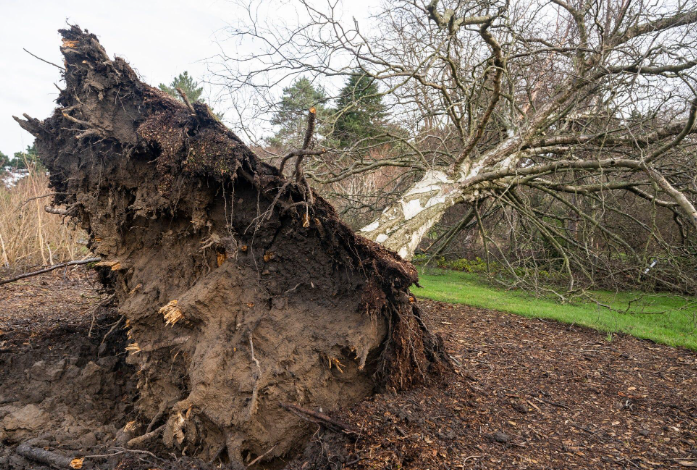
Windthrow
There is a word you may hear rather more often this winter: windthrow.
It is the forestry term for a tree being uprooted by wind rather than simply breaking. Its less dramatic relative is windrock — repeated movement in the wind disturbing a tree's roots and anchorage.
Trees are held upright by their root systems and the soil around them. Prolonged wet weather can reduce anchorage in susceptible ground, while shallow-rooted trees and trees whose exposure has recently changed can be particularly vulnerable. Timing matters too: a deciduous tree still carrying its leaves presents considerably more surface to the wind than the same tree once abscission* has taken place.
That doesn't mean booking speculative tree surgery. Check the stakes and ties on young trees. Think about what has changed since last winter: has a large neighbouring tree or hedge disappeared and left something more exposed? If a mature tree genuinely worries you, do get professional help rather than attempting amateur preventative surgery.
Otherwise, leave it alone. A mature tree that is going to come down in an exceptional storm may simply come down. You may not be able to change that, but you can move the Tesla.
The RHS has useful guidance on young trees and windrock for anyone who wants the practical detail.
*Abscission — a very rare word for leaf fall used almost exclusively by people who want you to know they know it.
(Need help? Click here to contact Olli for a free consultation and quote)
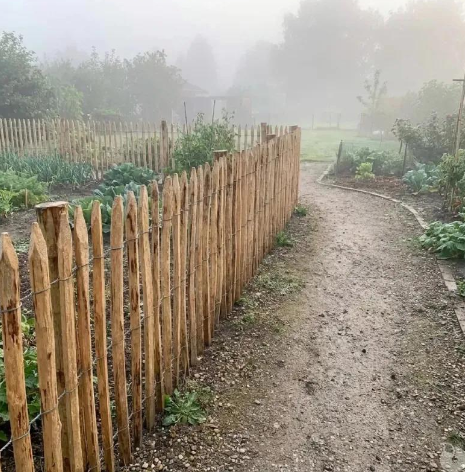
Before Everyone Else's Fence Is Lying in the Road
Trees are only the spectacular end of the problem.
Fences, gates, sheds, greenhouses and trellis can spend years concealing how knackered they are until the first serious gale asks a more searching question — so go now and wobble your fence.
Push the posts. Not the panels — the posts. If one moves at ground level, investigate why. Look for loose panels and fixings, gates that have started leaning, damaged trellis and branches that could spend a windy night repeatedly thumping into something expensive.
Then look at the fence itself, because there is a slightly counter-intuitive lesson here.
You might imagine that the best defence against wind is to build something completely solid and the jobs done — unfortunately, the wind is rather more devious.
The RHS recommends windbreaks that filter roughly 50–60% of the wind. A semi-permeable barrier lets some air through and reduces its speed; a completely solid one forces it over and around the obstruction and can create turbulence behind it.
That doesn't mean ripping out a perfectly serviceable close-boarded fence on Wednesday morning. It does mean that if you already have an exposed garden and a failing fence, replacing like-for-like isn't automatically the cleverest answer. Slatted fencing, trellis, woven hurdles, hedging or a combination may sometimes deal with wind rather better than simply putting another enormous wooden sail in exactly the same place.
And whatever type of fence you have, discovering the rotten post now is preferable to discovering it when the panel is halfway to Guildford.
It is also obviously worth understanding that if everyone's fences collapse on the same rotten night — it could be some time before things can be put right — so if your fence is going to go, your better option may be to get it fixed before the match starts!
(Need help? Click here to contact Olli for a free consultation and quote)

Securing the Garden
Set aside half an hour this weekend and walk around the garden with one question:
What happens here if it gets REALLY windy?
If you have younger children, take them with you. Leave a couple of harmless, obvious things for them to spot — an empty plastic pot, football or watering can — and let them work out what needs moving.
Then look at the less interesting things yourself.
The parasol. Garden furniture. Trampoline. Pots. Toys. Ladders. Anything propped against the shed. You don't need to dismantle the garden in September. Just decide now where these things will go if severe winds are forecast — and clear the space needed to put them there.
There is a small benefit for children too. If a storm eventually arrives, trees moving, things rattling and wind howling around the house aren't completely unexplained. This is the weather you prepared the garden for and explained to them in advance.
Most of this costs nothing. More importantly, it turns storm preparation from something done frantically after a warning appears on your phone into something already thought through.
(Need help? Click here to contact Olli for a free consultation and quote)
The Tiger May Never Arrive
None of this predicts that Surrey is about to disappear into the Atlantic. El Niño changes probabilities; it doesn't make appointments. November and December may be benign.
But that doesn't make the preparation wasted. A rotten fence still needed attention. Young tree stakes still needed checking. The paddling pool wasn't going to improve during January. And spending half an hour actually looking at your garden is rarely a bad investment.
Advance warning is a reason to do things, not to stop doing them. Autumn remains the time to prepare gardens for winter, undertake appropriate planting and pruning, clear what genuinely needs clearing and get necessary work booked while there is still time to choose when and how it is done.
If you'd rather I found the problems before the wind does, I have limited Garden Rescue availability this autumn.
And if the tiger does eventually turn up, at least there is a tin of tiger food waiting for him.
(Need help? Click here to contact Olli for a free consultation and quote)
Add comment
Comments