


Every winter we prune a lot of fruit trees. Every winter we also meet trees that somebody has had a spirited go at themselves. Sometimes the results are perfectly respectable. Sometimes you stand underneath one wondering what it did to deserve it.
There are plenty of excellent instructions online explaining how to prune an apple or pear tree. I am not going to offer you an inferior version of the RHS guide, which explains the mechanics perfectly well. If you want to have a go yourself, read their guide first.
The more interesting question is why two people can read exactly the same instructions, approach exactly the same tree and produce completely different results.
After seven years doing this professionally, I think the answer is simply experience. The principles of pruning aren't particularly difficult to learn; knowing how to apply them to the tree in front of you takes rather longer.
(Need help? Click here to contact Olli for a free consultation and quote)
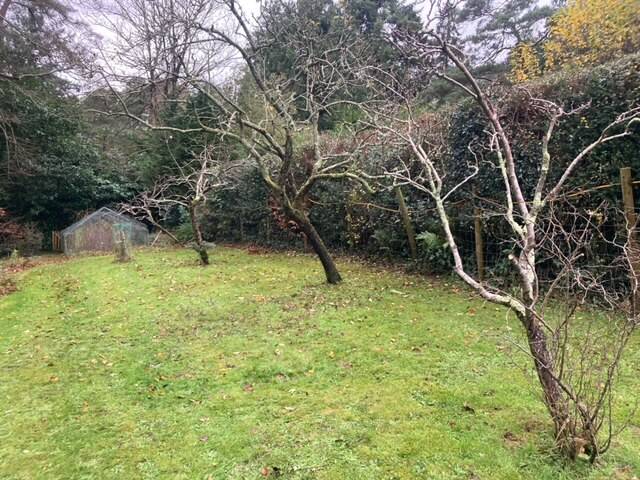
Knowing where to cut isn't the same as knowing what to cut
When we work on a fruit tree we are trying to maintain a healthy, productive tree with a sensible structure, allowing light and air through the crown while removing growth that is dead, damaged or no longer useful.
Real trees haven't read the manual. They come in different ages, varieties, shapes and sizes. Some have been carefully managed for decades; others haven't seen a pruning saw for years. One has grown vigorously in good ground, another is struggling in poor soil.
Scale matters too. Knowing the rules is one thing; standing underneath that tree and deciding what should still be there when you climb down is another.
After enough trees, the decision-making increasingly becomes instinctive. You stand back and begin to see the work before you start it. That doesn't mean there aren't rules behind the judgement; it means you no longer have to stop at every branch and consciously work through them.
Experience produces a better result in considerably less time, with rather fewer moments halfway up a ladder wondering whether you've just made a terrible mistake.
(Need help? Click here to contact Olli for a free consultation and quote)
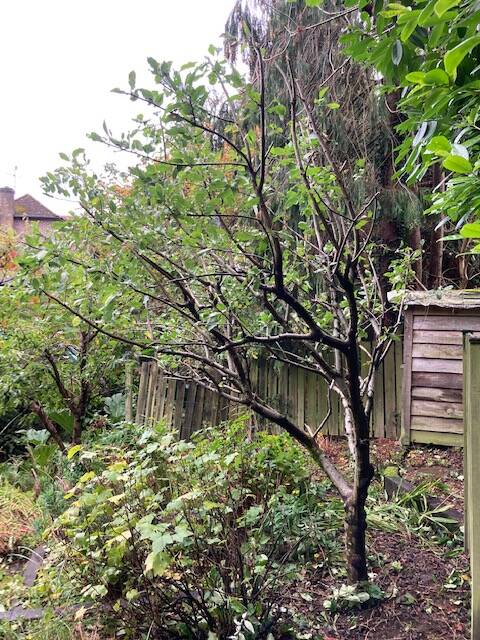
Three thousand years of interfering with trees
None of this is particularly new.
Humans have been deliberately cutting trees and managing their regrowth for thousands of years. Evidence of ancient pollarding survives in Britain from more than 3,000 years ago.
Some of the reasons were practical. Trees were repeatedly cut to provide timber, fuel, fodder and other useful materials. Pollarding moved the new growth high enough above the ground that grazing animals couldn't immediately eat it.
The reasoning may have changed, but the principle hasn't. Pruning is an intervention and before cutting anything we need to know what we are trying to achieve.
With an older neglected fruit tree, that often means working out what can sensibly be recovered — So if you've inherited one within a new garden, don't automatically assume the only choice is the chainsaw.
(Need help? Click here to contact Olli for a free consultation and quote)
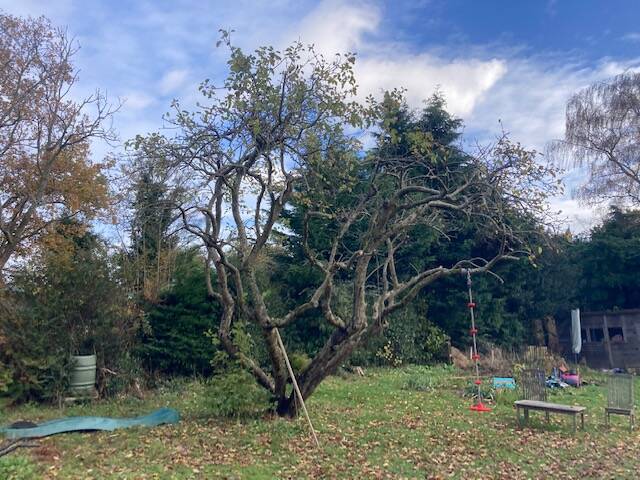
Twenty miles, Several Winters
I have no idea what the pruning season is like in Yorkshire or Kent and, professionally, I don't need to know. We work within roughly 20 miles of Haslemere. After seven years pruning fruit trees professionally here, I want most of the work done in November and December. Locally, the useful season is all but over by the middle of January.
Even within that relatively small working territory there isn't one winter. There are several.
Take just one small slice of it. Around Chiddingfold there is rich farming country — travel west towards Grayshott and Bramshott and within a relatively short distance you'll climb to very different heath and common country, with poor, freely draining sandy ground. Between and around them are mature woodlands, slopes, valleys, sheltered gardens and frost pockets creating still smaller variations.
I've repeatedly found that the useful pruning window around Chiddingfold farmland hangs on for several weeks longer than it does on the poorer sandy ground around Grayshott and Bramshott.
I don't know precisely why. Soil, drainage, elevation, exposure, shelter, frost and moisture are all tangled together. I am not going to invent an explanation because it sounds clever.
After enough winters, you notice the pattern — working out exactly why it happens is another matter.
(Need help? Click here to contact Olli for a free consultation and quote)

This year the apples are early too
The calendar has been particularly unreliable this year.
You could have pruned your trees or orchard beautifully last winter and still ended up with a poor crop. Months of sunshine should have been good news for fruit, but the lack of water changed the picture completely.
To discover the extent of this, I spoke to James Fitchett at Kilnside Farm near Farnham — who collects and presses fruit from local private estates and apples brought in by local growers. What he is seeing this year is striking.
He estimates the crop at around half a normal year and about a third of last year's exceptional harvest. At one small private estate they picked this week, they would normally expect around 75 crates. This year they got 20.
The apples are smaller and yielding less juice. James is also seeing far more diseased and rotten fruit than usual. He isn't certain why — although we discussed whether the unusually early ripening may be part of it.
Kilnside is already picking earlier because the apples are ripening earlier — another local observation that the season is running ahead after an extraordinary growing year.
That doesn't give us a new pruning calendar, but from experience I already expect our useful winter-pruning window to arrive and finish earlier than broad national guidance suggests.
So I won't be waiting until January. We start in November.
If you have too many apples, use them
Some trees will have somehow still produced plenty, and Kilnside provides a useful destination for the inevitable surplus.
Their apple swap is simple: take in 15 kg of apples, which produces roughly seven litres of juice, and you receive half a litre back.
For anyone currently looking at a tree layered with apples they are never going to eat, that seems a considerably better destination than the usual progression through wasps, rot and the compost heap.
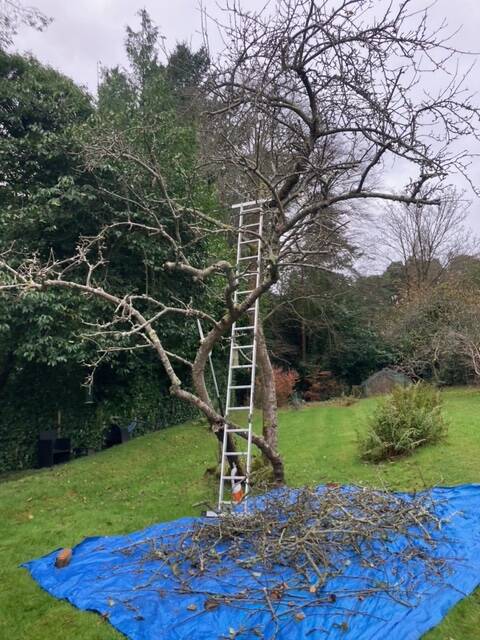
Before the leaves come down
There is one final reason I am writing this in September rather than waiting until the leaves are on the ground.
I have approximately 20 fruit-tree pruning slots available this winter.
Those are slots, not trees. Three smaller trees may fit comfortably into a day's work; a large neglected apple can occupy the entire day and occasionally more — unless I have been to you before I will need to arrange a visit to review the project and agree a price.
Once the available winter time is allocated, that's it — The pruning starts in November. Booking starts now.
If you have an apple or pear tree that needs attention this winter, now is the time to get it booked in.
Click to Contact Olli or call 07967 995 705
for a free consultation and quote
Add comment
Comments