

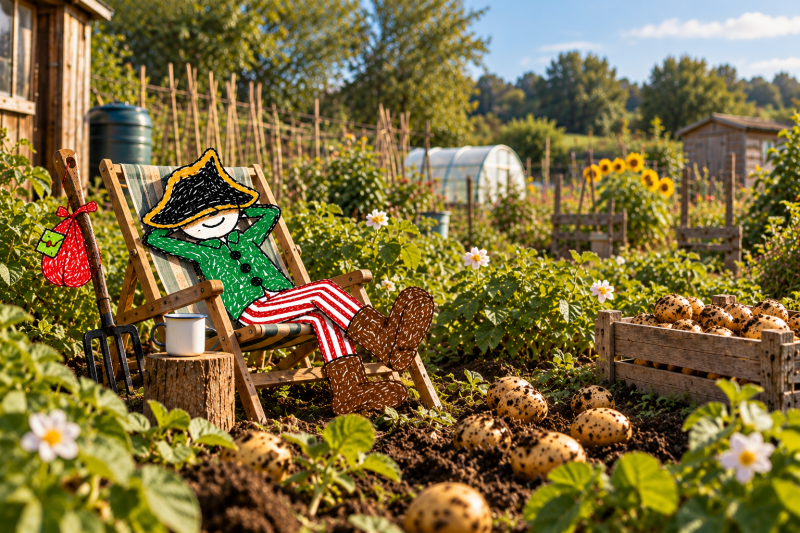
In 1607, Captain Pouch led thousands of people across the Midlands, tearing down enclosure fences and creating a right bally-hoo-ha.
Nearly four centuries later, two men argued over dead clematis cuttings on an allotment in Leicester.
One of them went to his shed, collected a pistol and shot the other stone dead.
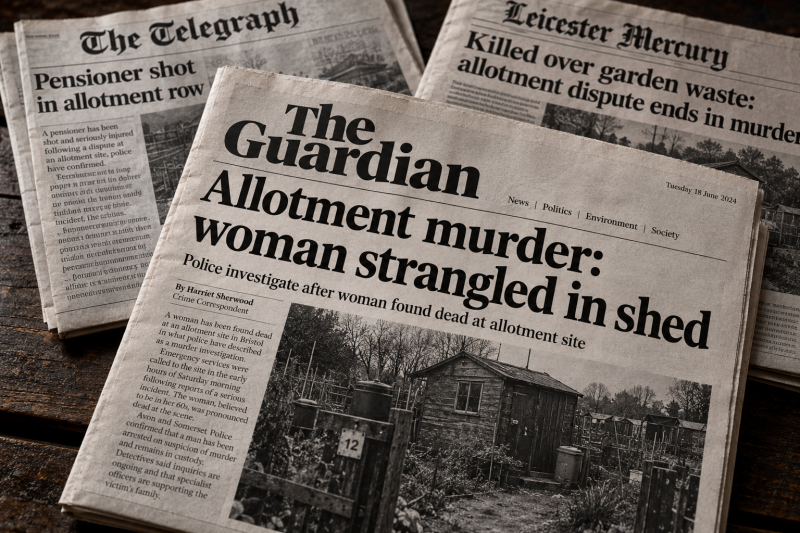
People Are Still Paying the Ultimate Price For Allotments
Sandor Bata was 73. His victim, Michael Willson, occupied a neighbouring allotment.
They had argued for months about access and garden waste. The final dispute concerned dead clematis cuttings left in Bata’s compost heap.
Bata went to his shed, collected a pistol and shot Willson. He then took a bus into Leicester, drank a pint and telephoned the police. In 1998, he was convicted of murder and sentenced to life imprisonment.
Nearly twenty years later, another allotment dispute ended in murder.
Lea Adri-Soejoko was secretary of the Colindale Allotment Association in north London. In 2017, she was found dead in a locked mower shed — strangled with the starter cord of a lawnmower. A fellow plot holder, Rahim Mohammadi, was convicted of her murder after a retrial. The prosecution linked the killing to his fear that he was going to lose his allotment.
There is nothing comic about either case. They matter because they destroy the comfortable idea that furious territorial disputes over small pieces of growing land belong to a vanished Britain.
The implements changed. The intensity did not. Perhaps the only thing that has changed is that, for better or worse, the state sanction for violent murder is now less than it previously was for stealing a potato.
Everything Else Changed
Between Captain Pouch and the modern allotment came multiple agricultural and industrial revolutions.
Britain acquired factories, railways, electricity, cars, aircraft, motorways and supermarkets. We split the atom, put people on the Moon, built computers, connected the world through the internet and placed more information in a telephone than Parliament once possessed in its entirety.
Food ceased to depend visibly on the ground around us. Potatoes arrived washed, bagged and graded. Most people could pass their entire lives without knowing who grew them or where.
Captain Pouch should have become irrelevant — a relic of subsistence past.
Yet incredibly the desire he represented, a small patch of land to grow your own potatoes, survived every transformation no matter how radical. This suggests that Captain Pouch's actions were not simply those of a smelly, stupid idiot — but basically instinctive.
People still want a small piece of land they can cultivate themselves.
They want to plant potatoes, argue about territory, complain about somebody else’s bonfire, lose tools, acquire too many courgettes, drink beer in a dusty shed and become unreasonably interested in the conduct of neighbouring chickens.
As the world becomes more and more detached from our collective roots, the allotment survives not because the world stands still, but because it does not.
There Still Isn’t Enough Dirt
Nobody knows exactly how many people are waiting for an allotment in Britain. This is not because the number is too small to matter. It is because the Government does not hold a national total. Waiting lists are maintained separately by local authorities, using different systems and producing an incomplete national picture.
One recent estimate put more than 170,000 people on council allotment waiting lists — the precise figure is uncertain. The shortage is very much not.
The law still recognises that demand matters. Under legislation originating in 1908, local authorities must consider providing allotments where sufficient demand exists and may need to acquire suitable land — as we have seen this consideration may take some time and very likely involve elephants.
Yet the Government has made no sign of intending to carry out a formal national assessment of how effectively that duty is being met.
Research cited by the RHS found that 90 per cent of first-time buyers regarded access to a garden as essential to their quality of life — yet there is no general UK-wide legal requirement for every new home to include a garden or even somewhere basic to grow food.
Captain Pouch has acquired a smartphone — yet he is still looking for somewhere to plant potatoes.
So Somebody Reinvented the Allotment
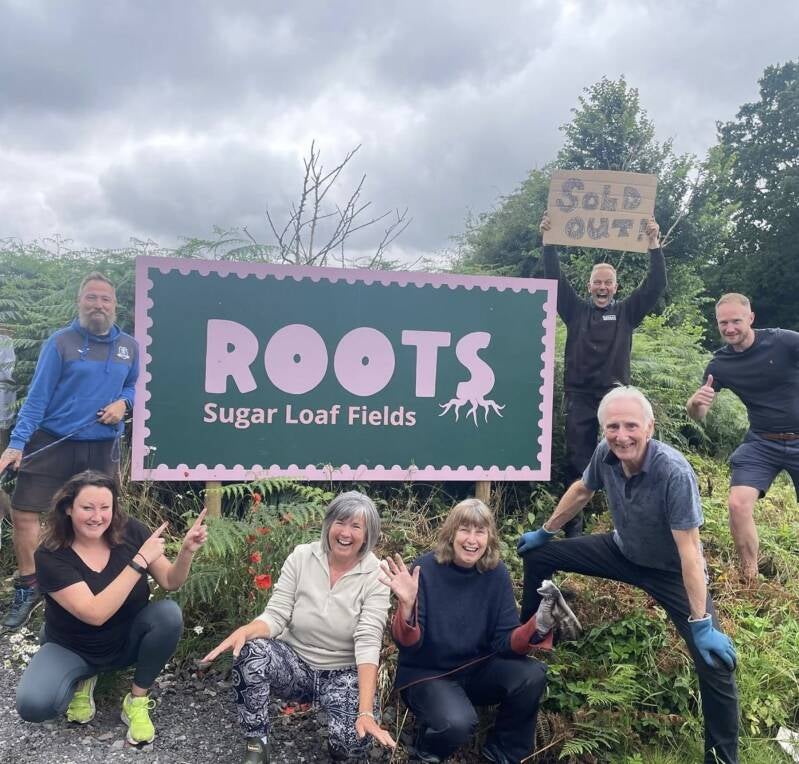
In 2021, a business aptly named Roots began offering another answer. Roots leases farmland, divides it into ready-to-grow plots and rents them to customers by subscription. Instead of joining a council waiting list and hoping a plot becomes available, a customer pays for prepared growing space, tools, facilities and support.
Within five years, Roots has expanded to 20 sites. Its published ambition is to reach 1,000 by 2033. Reports describe nearly 5,000 customers, and several existing sites show very high occupancy.
The demand is clearly real (and as we have seen so far very unlikely to decline). As with most businesses that have identified and are aiming to address a specific market failure, the model is neither automatically heroic nor automatically sinister — it's just business — there is a clear gap to be filled. It puts growing space within reach of people who cannot obtain a
conventional allotment, but it also potentially turns access to land into a commercial service rather than a public good. That opens yet another of Pandora's vegetable boxes and raises myriad legitimate questions about affordability, landscape, traffic, infrastructure and the use of agricultural or Green Belt land.
Sadly, it also returns us to our favourite question which seems to have to be asked again every time Parliament thinks it has been answered.

What Exactly Is an Allotment?
At Abbots Leigh near Bristol, Roots secured confirmation that using land for allotments fell within agriculture and did not, by itself, amount to development requiring ordinary planning permission.
Growing fruit and vegetables remained agriculture. Finally some clarity! Hoorah! Not so fast! Everything required to make the modern site function was more complicated — surprise, surprise.
Containers, access arrangements, hardstanding and CCTV required separate planning consideration. When approval came in July 2025, it brought detailed conditions. Containers were to receive timber cladding. CCTV posts were to be dark green. A gate could be 4.8 metres wide. The office and tool store could be used only during prescribed hours.
The cultivation was agriculture — the apparatus surrounding it was development. Opponents raised objections about planning, traffic, landscape and the environment. Such objections are not, again, as history continues to repeat, illegitimate merely because the proposed use involves people growing their own potatoes.
But the opposition did not always remain inside the planning system.
Reported sabotage at the Bristol site included cement in gate locks, deflated digger tyres with superglue in their valves, vehicles repeatedly used to block access and grass seed scattered over fresh compost.
Four hundred years after the enclosure riots, people are still interfering with fences and fighting over who should use a piece of land.
As Ever Nothing is Simple
We did try to ask Roots about all this. Several attempts to contact its founder, Christian Samuel, went unanswered. The other founder, Ed Morrison, has since left, the website of Everwonderd, its PR company, no longer appears to be operational, and we can find no further updates on the Roots press page since March.
As usual with allotments, things are apparently far more complicated than they may first appear.

Captain Pouch Was Here All Along
Captain Pouch failed in 1607 — or did he? His supposedly magical pouch contained no weapon capable of defeating the authorities and the bureaucrats (that has yet to be invented). When opened, it was said to contain nothing more formidable than a mouldy cheese. The fences stayed up, the revolt was crushed and his demand for access to land appeared to have been defeated.
But perhaps what was in his pouch was not just cheese after all.
Britain never got rid of him completely. Instead, it spent four centuries attempting to accommodate him.
Landowners provided plots to improve his character. Committees regulated his Sundays. Parliament defined his garden, protected his hens, expelled his pig, valued his manure and considered whether he could take his apple tree away when he left.
The courts birched their children over eggs, imposed hard labour over marrows, transported vegetable thieves and recorded a sentence of death over a simple potato.
Wartime MPs worried about walkers with one foot on an allotment — clearly history exaggerates the innumerable dangers actually posed by the Nazis?
Modern planners distinguish the agricultural potatoes from the operational CCTV watching over them. Councils maintain waiting lists they cannot satisfy. Businesses then lease fields to meet the demand. Neighbours again object.
Gardeners argue. Occasionally, appallingly, people kill.
Britain could have abolished the troublesome things. Sainsbury's opened in 1869, Morrisons 1899 and Tesco 1919. It did not. Why is that? It is clearly the obvious thing to do. How can anything be worth this much trouble?
Parliament regulated, protected and provided allotments because the desire behind them was never eccentric or marginal. It was shared by labourers, reformers, councillors, tenants, homeowners, apartment dwellers and generations of people who simply wanted to grow something of their own.
Captain Pouch was not one strange man with a ludicrous piece of cheese - he probably didn't even have stupid red stripey trousers.
He was the person waiting years for a council plot. He was the tenant digging potatoes by moonlight. He was the gardener carrying home an apple tree, the neighbour complaining about a cockerel and the subscriber paying for a prepared patch of under siege farmland outside Bristol. He is anyone who has looked at a bare piece of earth and imagined food coming out of it.
We are all Captain Pouch.
Because after four hundred years of revolutions, engines, aircraft, computers, satellites, smartphones and artificial intelligence — all anybody really wants is a little bit of dirt on which to grow some potatoes.
And THAT is remarkably complicated!
If you have missed any of the previous Allotment Wars series please click the links below:
Allotment Wars II: Save Waste — Start a Pig Club.
Allotment Wars III: Crime and Punishment. That Potato Could be the Death of You.
Add comment
Comments